Parent-child course listings allow the registrar to maintain separate course registrations and transcript records while maintaining a single instance of the course in the Learning Management System (LMS). Those courses may consist of a combination of students in different academic levels (e.g., undergraduate and graduate). While they may meet together, they are distinct courses with separate course codes. More information on the distinction between cross-listed and parent-child courses can be found here.
Faculty should communicate directly with their school dean or program director to ensure that best practices within schools and programs are adhered to. These are general guidelines for delivering content in a parent-child course at Carolina University.
Identify the different courses and learning outcomes associated from the current catalog. A separate syllabus is required for each course, regardless of how many courses are connected in the LMS.
It is important to use the same grade weighting method in all associated courses for the parent-child listing. While the grade levels may vary, a single gradebook is implemented.
Weighting by point value allows the faculty to score a different number of assignments or provide different point values to assignments while maintaining the same gradebook,
Weighting by type requires that the faculty use the same type percentage (e.g. Exams=20%, Participation=10%, etc.) for all students. Differentiation can still occur in the number of assignments, requirements for the assignments, or grading rubrics.
If there are two different grading scales represented in the parent-child listing (i.e. Undergraduate and Graduate), the faculty member should configure the gradebook for Grade_Only and submit grades in accordance with that method.
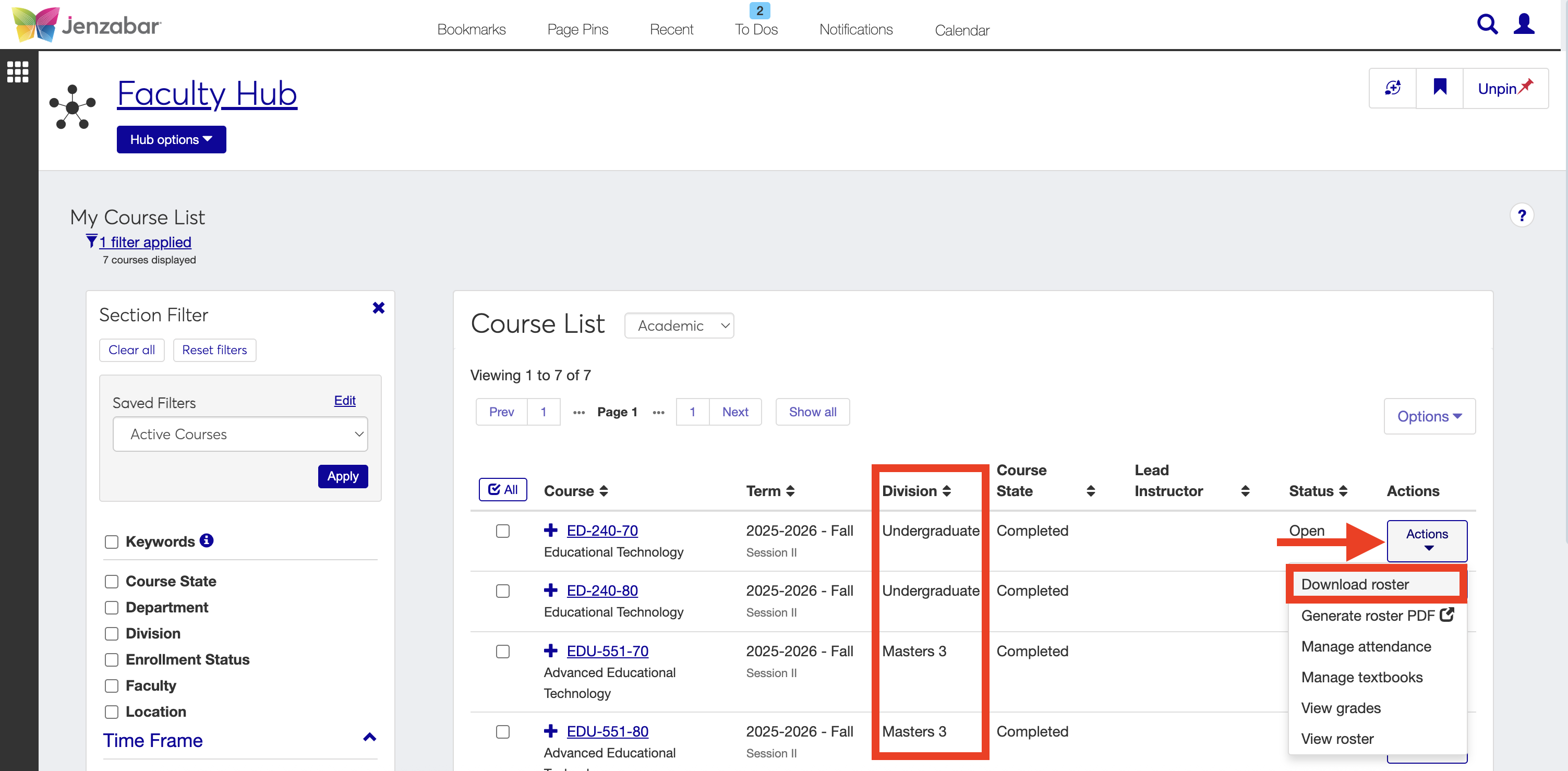
Faculty should identify which students in the roster belong to which group. This is accomplished by accessing the course rosters in J1 Web: Student>Faculty>Manage my course list.